Let’s have a cup of coffee in China: everyone at Caffè Italia

by Carlo Odello

Trainer and member of the board of the International Institute of Coffee Tasters

We all knew the International Institute of Coffee Tasters was landed in China. We held the first Espresso Italiano Tasting courses in Guangzhou and Beijing in December 2010. Thanks to our member of the board Darcy Sun, from March of this year, our manual Espresso Italiano Tasting is also available in Chinese. Furthermore we organized in July a new series of training courses and seminaries.

Now we are back again in Guangzhou where the International Institute of Coffee Tasters together with the Italian Espresso National Institute has patronaged a new edition of Caffè Italia. So, after the editions in 2010 held in Tokyo, New York and Paris and the 2011 Tokyo one, a new building block is added to the plan of spreading the real Italian espresso culture.

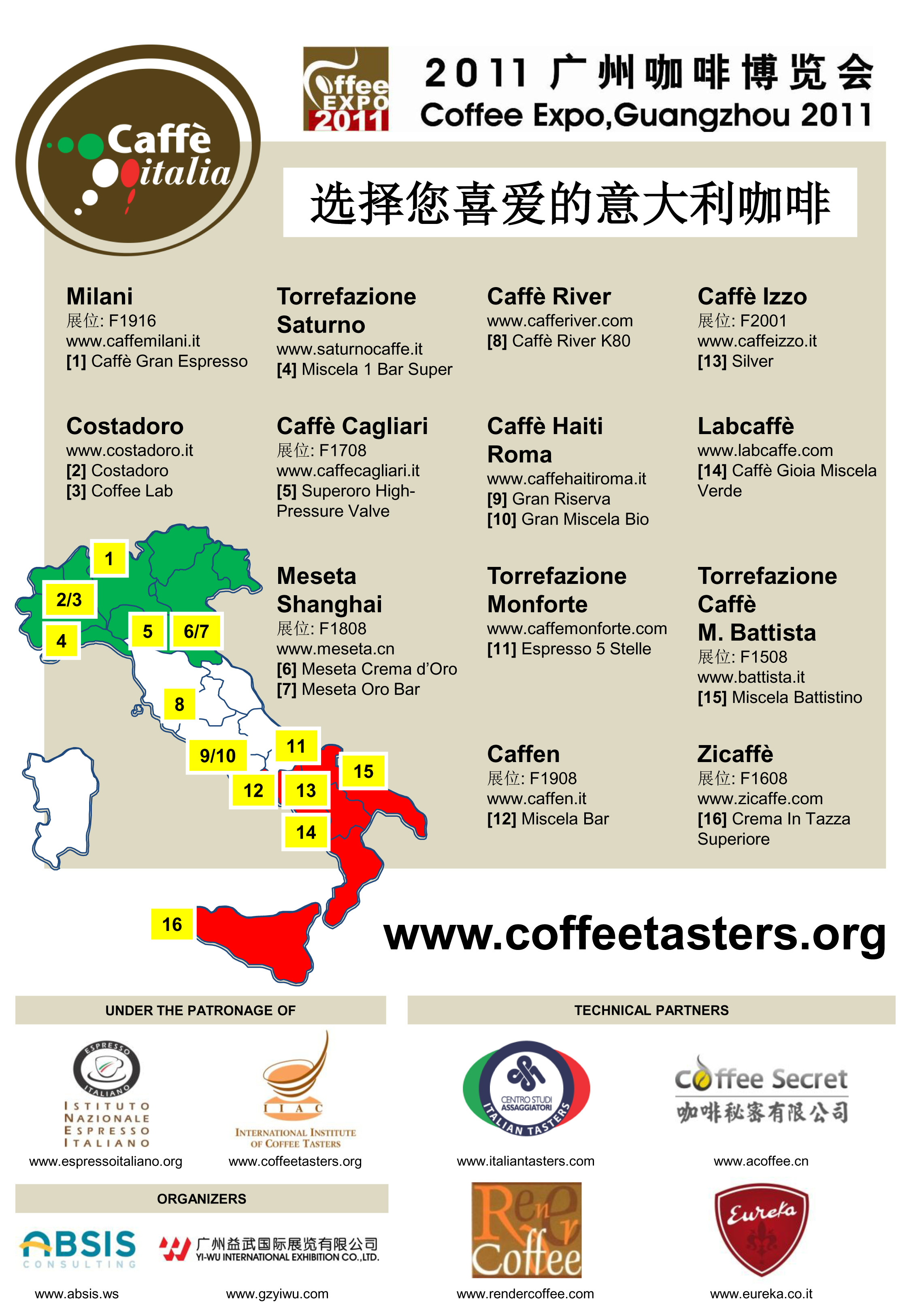
From 24th to 27th of November a Caffè Italia strengthen by the presence of 16 different blends will enter the scene during the Guangzhou Coffee Expo 2011. A tasting point proposing the Iespresso in its regional variations to the Chinese public, ranging from the region of Piedmont to Sicily. There is just one idea in mind: to continue spreading our espresso principles in China.

What is the most challenging thing of this new Chinese episode? The fact that Caffè Italia knew how to capture the attention of more roasters, a lot of which will be present in the area (if you are curious to know who they are, I redirect you to the coffee list that follows). The journey of our espresso in China is rather long but meanwhile we are making our way, and we sincerely thank those who are supporting us.  

Caffè Italia at Guangzhou Coffee Expo 2011, click to enlarge

Lessons under the green tree

by Carlo Odello

Trainer and member of the board of the International Institute of Coffee Tasters

The world of coffee shops in Italy is afflicted by a widespread lack of planning. A small number of coffee shop owners know their business and are able to plan and are joined by hordes of operators living hand to mouth. Although outside Italy the situation is not always at its best, it really depends on the country taken into account, you generally meet sharper operators who think in real terms of marketing.

GREENTREECaffè is one of these cases. Vittorio Ventura and Dana Hruba have created a chain of coffee shops in Bratislava; to be precise, five coffee shops in only two and a half years, in a very competitive market such as Bratislava. The Slovakian capital has only half a million inhabitants but is a remarkable tourist crossroads surrounded by Vienna, Prague and Budapest. This is why at least two other chains other than GREENTREECaffè exist, everyday playing “the coffee battle” in the city. It is obvious that the staff at GREENTREECaffè plays on Italian espresso and related products.

GREENTREECaffè is now the first Permanent Training Point of the International Institute of Coffee Tasters in Central Europe. The coffee shop in Venturska, with a splendid room with hundred-year-old vaults, within the last few days has entered into the International Institute of Coffee Taster’s network, bringing the number of the Permanent Training Points to 28 (four of which are outside of Italy: Stuttgart, Dneperpetrovsk, Tokyo and now Bratislava). To inaugurate the Institute new embassy, on Saturday 5th November a Espresso Italiano Tasting course was held to license new coffee tasters, which followed the course held last year by GREENTREECaffè. 

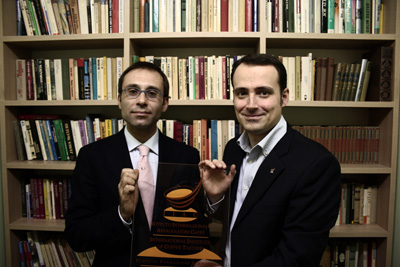
Vittorio Ventura receives the plaque for the GREENTREECaffè’s new Permanent Training Point in Bratislava. Photos of the new PTP are available on our Facebook page.

Italian Espresso tasting course just before the Host show in Milan (20 October 2011)

by Carlo Odello *

We just scheduled an Espresso Italiano Tasting course just the day before the Host show in Milan (20 October 2011). Many professionals wrote us asking about this course: here it is! The course will take place in Brescia, hometown to the International Institute of Coffee Tasters. This means just 1,5 hours fom the Host show in Milan.

Why should you attend an Espresso Italiano Tasting course? I can think of many good reasons, but one seems to me the most important: to go back to the roots of Espresso, to understand the culture in which it was born.

I have been working in the coffee business for some years (not counting the years I was at the university but already spent some time at the events of the International Institute of Coffee Tasters and of the Italian Espresso National Institute). And I have been travelling around the world in the last few years training people how to taste Italian Espresso.

What did I discover? Easy to say: coffee is culture, means it is strongly connected to real life. It is like Chinese tea: you cannot understand it unless a Chinese explains it to you. That’s because he or she is Chinese and was born and raisen up in the real Chinese tea culture. The same for Japanese tea. And for any other specific tea culture.

Let us make you discover the real Italian Espresso culture. If you are interested in understanding how to recognize and evaluate the real Italian Espresso, just download the brochure from the link below. You can also drop me an email at carlo.odello@italiantasters.com if you need further information about the course.

Download:

Italian Espresso Tasting course: brochure (PDF)

* Trainer and member of the board of the International Institute of Coffee Tasters

Italian Espresso in China: new book and new courses

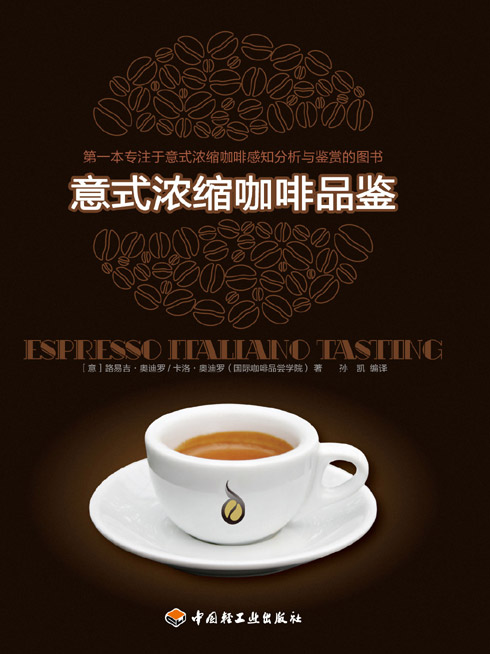
 Espresso Italiano Tasting Chinese

Espresso Italiano Tasting, the official handbook of the International Institute of Coffee Tasters, has just been published in Chinese. And more courses and seminars on tasting Italian Espresso are coming in Guangzhou next week (July 26th-31st). The classes will be held by Carlo Odello, member of the board of the International Institute of Coffee Tasters. For  more information about the courses and the book please contact Ms Jolin (jolin@acoffee.cn).

Be a protagonist of the world’s biggest Italian Espresso event!

Coffee Experience, the world’s biggest Italian Espresso event, is returning again this year to Verona from 7th to 11th April. The figures for 2010 have been impressive: 35 coffee blends available for tasting, more than 7,000 Espresso coffees served over five days.
If you want to put yourself to the test, then send us your application! We are looking for two baristas who will be at the centre of the Coffee Experience scene. We offer our baristas food and accommodation in Italy, and the possibility of a true and unique experience in the world of Italian coffee. Please write to carlo.odello@italiantasters.com.


Caffè Italia, the Italian Espresso event at Foodex 2011, Tokyo

The International Institute of Coffee Tasters will organize a new edition of Caffè Italia, the Italian Espresso event, at Foodex 2011, the most important food exhibition in Japan (Tokyo, Makuhari Messe, Hall 3, booth C01, March 1-4).

The second edition of Caffè Italia will give visitors the opportunity of tasting six different Italian Espresso blends and evaluate them. For the first time visitors will have to judge the espresso blends using a tasting card. Caffè Italia will also host training sessions held by Chihiro Yokoyama.

Carlo Odello, member of the board of the International Institute of Coffee Tasters and communications manager of the Italian Espresso National Institute, will be at Caffè Italia, too. "We aim at spreading the culture of the real Italian Espresso and Caffè Italia is a great opportunity for us – Mr Odello said – Japan proved to be very sensitive to Italian Espresso, we now have more than 300 tasters in the country. We recently launched the Espresso Italiano Tasting classes in China and are looking for partners in other Asian countries such as Korea and Thailand".

Caffè is organized in cooperation with the International Institute of Coffee Tasters – Japan, the Italian Espresso National Institute and the Italian Trade Commission.

For more information: info@coffeetasters.jp, carlo.odello@italiantasters.com.

First Espresso Italiano Tasting courses in China: Guangzhou, Shanghai and Beijing

The first Espresso Italiano Tasting courses will be held in China in Guangzhou (December 27-28), Shanghai (December 30-31) and Beijing (Jan 1-2).

Carlo Odello, trainer and member of the board of the International Institute of Coffee Tasters, will teach the classes. Mr Odello will also attend the Coffee Expo in Guangzhou (December 23-26).

The courses are organized in cooperation with Coffee Secret Company. For more information please get in touch with Mr Darcy Sun Kai: +86 (20) 62352855, darcysunkai@gmail.com.

Espresso Italiano Tasting seminars in Seattle, WA

The International Institute of Coffee Tasters, in collaboration with Caffè Umbria, will bring its Espresso Italiano Tasting seminar to Seattle this fall. Carlo Odello, board member and trainer of the Institute, will explain the characteristics of a true Italian espresso and the correct methods of evaluation. The seminar will open with an introduction to sensory analysis of Italian espresso through the analysis of the main stages of evaluation: visual, olfactory, gustatory-tactile and aftertaste. In the aroma portion of the course, we will explore the fundamental aromas and most frequent flaws and their causes. With the help of the Italian Espresso Trialcard, the official espresso evaluation guide of the International Institute of Coffee Tasters and the Italian Espresso National Institute, we will taste, compare and discuss three different espresso extractions. 

Each seminar includes:

  • Espresso Italiano Tasting, the official manual of the International Institute of Coffee Tasters
  • The Italian Espresso Trialcard, the official espresso evaluation guide
  • Three espressos for the purpose of instruction
  • Certificate of Attendance

Dates and times:

  • Saturday, October 30, 9:30 to 12:30
  • Sunday, October 31, 9:30 to 12:30

Registration Deadline: October 4, 2010

For more information and registration, please click here or write to annamaria@caffeumbria.com

Quality of coffee: for some companies it is a taboo

by Carlo Odello

Have you ever tried to drop a line to the customer service of the big multinational coffee companies? We have and we have posed them the sort of question that any careful consumer asks himself: how do you check the quality of your product? We found the address of the customer service or, if they did not have one, the name of the most appropriate person on their corporate websites. We wrote to the companies using a private email address and signed the request. We asked them all the same question: which method do you use for measuring the quality of your product?

This is an unnecessary question when it is down to quality in other sectors. It is already a few years since the car manufacturing industry, just to give an example, has started publishing the results of its safety tests and devotes special focus to them when promoting its product. Coffee is a different story: some companies show the plantations in their ads on television and some others take you in paradise. The overall impression is that not all of them are ready to openly deal with the issue of quality. This is, as we shall see, confirmed by our brief, albeit, accurate analysis.

We had three different categories of replies. Four companies – Nespresso, Illy, Diedrich and MacDonald’s – explained to us in sufficient detail how they measure the quality of the finished product. Vague replies category: Starbucks suggested we should visit their corporate website (which was not that useful), Nestlé replied they would have come back to us. Lavazza told us that quality tests take place everyday and that these tests are certified. The other four companies – Tchibo, Sara Lee, Dotour and Segafredo – have not even replied. We have not been able to contact Costa Coffee because there was no useful contact indication for the common consumer on their website.

Here goes what McDonald’s, Diedrich, Illy and Nespresso said. The Italy customer service for McDonald’s ensured that they use “only products and ingredients that match the highest quality standards and that have been officially approved by competent authorities”. They informed us that “the choice is made on organoleptic evaluations – defined by a panel of tasters – representing the average consumer – who has positively rated the current supplier”. Diedrich gave a more detailed reply saying that the coffee samples are tested before purchase and delivery and that they are also subject to a visual evaluation aimed at spotting any defects of the green coffee. Each roasting process is cupped before it goes to packaging. Also Illy provides great details, informing us that they select the coffee batches and then they make an electronic control on the colour of the beans so that they can discard the flawed ones. They also add that, during the production process, 114 checks are made. From Nespresso, we received a reply by their technical & quality manager Alexandre Bolay (perhaps they smelled the rat?). He said that all throughout the production line there are quality inspections and tasting sessions. The daily production is benchmarked against a reference production: blind testing is done and if the correspondence between the sample and the reference product is lower than 60%, corrective measures are applied to the recipe.

These were their replies. Said this, our test was mainly on the external relations of these companies. The interesting thing to note is that from at least two thirds of the companies we had no useful reply. Actually, Tchibo, Sara Lee, Dotour and Segafredo have not replied at all. We thought this was a bit odd given that quality is the battle field of a wealth of marketing and communication initiatives. In particular, Starbucks vague reply comes as a surprise: they said that, due to the volume of queries they receive, they cannot give interviews or reply to requests for data or provide information on the company other than what is already in the public domain. This comes in a moment when Howard Schultz, Starbucks CEO, is fighting against what he defines as a weakening of the Starbucks experience.

In general, talking about the absent companies, and they did this deliberately, we get the impression that their marketing is still based on the assumption that the consumer is passive. They do marketing strongly focusing on promotion rather than information. The point is that now the consumer, when choosing the product, relies on means like other people’s opinion and the Internet which are not that sensitive to the sort of imposition-based marketing style.

Coffee in the UK: future impossible for those who do not offer quality

by Carlo Odello

We met Gennaro Pelliccia, Production Technical Manager at Costa, he makes sure that the quality of the coffee they produce is good value-for-money. He started off with Costa as a barista in December 1991, then he joined Gino Amasanti at the Roastery in 1997 after his studies in Mechanical Engineering.

First of all, let’s find out something more about Costa: its history and what it is today.
Costa was set up in London in 1971 by two Italian brothers, Sergio and Bruno Costa. The two of them noticed that there was some demand for good-quality, blended coffee so they started supplying such a product to catering services and specialised Italian coffee shops in the UK. In 1978, the Costa brothers opened up their first store in London. This was the beginning of their expansion with two new selling points being opened every year. In 1988, they moved to a bigger site, in the Old Paradise Street, in the Lambeth area, south of London. In 1995, Costa was acquired by the Whitbread Group: at the time it had 41 stores all around the country. Today it is the leader in its sector and it is also the operator growing at the fastest pace: at present, it has 600 stores in the UK and 222 abroad.

What does the coffee market in the UK look like?
According to April 2007 figures, there are approximately 9.300 stores which comprise branded coffee shops, independent and unspecialised operators. It is assumed that there will by a growth by 4.2% per annum which will lead to having 11.000 stores in 2010. As for branded coffee shops, the big chains market, from 2001 to 2006, there was a 10% growth per annum. At present, there are 2.973 stores of this type in the UK: the market share of the branded chains accounts for 32% of the global British market; this percentage should get up to 37% by 2010.

Do you believe that there is still margin for growth for Costa?
Yes, undoubtedly. Twelve years ago we carried out an investigation that made it clear that the market was open to the creation of places, not dominated by males, as is often the case with pubs, where people could meet. This was the ground on which the further development of Costa was built. There has been a positive growth trend for coffee shops also due to a major change in eating habits in the UK over time. Today people do not eat at home most of the time and tend to prefer quick snacks. This is the reason why the coffee shop is the ideal solution.

Let’s speak about quality in the UK.
No doubts that over the last 10 years espressos and cappuccinos are much better in our country. This is also thanks to the clients. Over the last five years, our most evolved clients – those that, after having been to Italy, asked us to offer products which were to a greater extent Italian-style. In addition, the attitude to the product is different: once upon a time, the espresso was chosen because it was probably the cheapest option on the menu. At the beginning there was also a certain linguistic concern triggered by words the pronunciation of which was deemed to be difficult, e.g. ‘caffè espresso’ or ‘latte macchiato’. Actually, nowadays, it is a real choice, part and parcel of the life-style.

How about the future?
This looking for Italian-style products and for better quality will not cease: whoever will not be able to meet this need will have no chances in the market. The next step will actually be the choice of the coffee shop depending on the quality. Costa has already prepared itself for picking up this challenge in an effective way. We measure ourselves against the parameters set by the Italian Espresso National Institute and we use machines and grinder-dispensers that are certified by the Institute. However, the monitoring is not just downstream, at the coffee shop, it starts well in advance on the entire production cycle.

Back to British consumers, do they tend to be loyal to brands?
They are, first of all, loyal to the experience of taking an espresso or a cappuccino in a certain type of place. For example, several clients of Costa are professionals who stop at the same coffee shop on their way to work or when returning home. Our baristas know their tastes and make them feel as if they were at home by offering a tailor-made service. So the clients are loyal because of that atmosphere and that place which looks familiar to them. The very wide product range gives them satisfaction and plays a role in making them loyal.

What is your view on single-dose coffee pods, and, more in general, on any solution that makes the espresso experience possible without a coffee shop?
In the UK there is for sure a developing market for consumption at home of this type of products, though we must not forget that most of the coffee drank at home is instant coffee. The single-dose coffee pods, or other solutions of this sort, are still not too common neither at home nor at the office. In the UK they are becoming increasingly popular at places that are not specialised in coffee, e.g. pub restaurants, where at the end of a meal some clients simply like to have a cup of coffee. In these places, the low sales volume and the high frequency in staff turnover make it difficult to afford having the proper complete machinery and the blend in the form of beans. This is the reason why they opt for the professional espresso machine with filter-holders for single-dose coffee cartridges. Also in the Costa stores we use this sort of solutions for the decaffeinated and Fair Trade products in order to be able to serve a product which is always fresh.

What is the policy of Costa Coffee on the international stage?
Currently, we have more than 200 stores all over the world: Ireland, Eastern Europe, Middle East, India and Pakistan. For the moment being, we have got no plans to enter Italy where there are already independent and well-rooted suppliers that provide an excellent product to the country. In general, in Italy, branding policies are not too strong yet.